 |
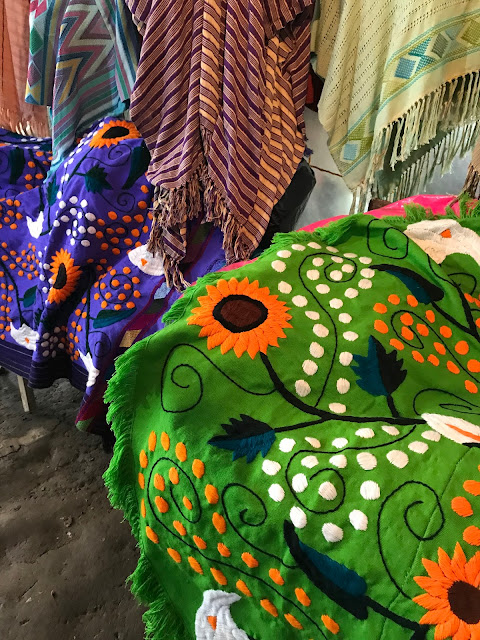
| Magically beautiful textiles in a shop in Zinacantan |
It’s a cloudy cool October morning in Chiapas, and lucky for
me, my compadre Lynne has been in this region several times and knows the ins
and outs of travel here. I’ve heard so many stories about these highland
villages I can’t wait to see them for myself. The indigenous people in this part of Chiapas
are Maya by descent and most speak Tzotzil, a Mayan language, and many speak
very little or no Spanish.
 |
3 Mayan Crosses in Zinacantan. The Mayan use a long needle pine which is symbolic to them and you see it in churches and cemeteries. It is the representative of the Tree of Life.
|
Each municipio
(municipality) here has its own laws, rules, regulations, traditions and
practices; which means go with a guide in order to prevent offense to the local
folk. In some cases, annoying people like the Chamula and trespassing on their
rules and laws can result in some pretty dire consequences to the tourist. More
about the Chamula later but first we are off to see Zinacantan.
 |
Off to pick up all the rest of our tour. Tricked out Pick up trucks were everywhere in Mexico. I'm still trying to figure out the significance.
|
Ask your hotel for recommendations about tour guides or you
can do your own research on the internet. Our hotel, the Parador Margarita, took
impeccable care of us and their recommendations were always made with the best
interests of the guest in mind. We
arranged to be picked up at 11:00 in the morning and our guide showed up to get us in a touring van/bus
vehicle that seated about 12 people. Of course, we were first to be picked up
and we spent the next hour trotting from hotel to hotel picking up the rest of
our tour mates.
 |
Our tour guide was a native Mayan from the area. He knew everything about what we were seeing.
|
We finally hit the road; Americans, Mexicans, a South
African and a pair of Brazilians. We
left San Cristobal and headed up into the hills through what I would loosely
call suburbs, past a giant shopping mall, strangely enough, and a lot of car
dealerships. It was raining in earnest and I was glad I had dressed in layers
and had a hooded jacket. Our guide pulled over in front of three blue green
wooden crosses at a raised spot next to the road and we all piled out. He asked
who spoke English and put those folks to one side while he gave his spiel in
Spanish to the rest of us.
 |
| The Street of the Lost Child, and Zapatista signage in the village. The Zapatista uprising was in 1994 and its still going on, although more quietly. |
It was basically
background on who the people were we going to see, their belief system and how
it worked and tourist etiquette. The Tzotzil, according to our guide, have a
religion that is a blend of Roman Catholic and Mesoamerican beliefs, known as
syncretism. According to our guide traditional belief says there is a Tree of
Life, called the yaxche or ‘ceiba’ which serves as the communication center
with the levels of the world. Roots in the underworld, tree on the earthly
plane and the top in the heavens. The three levels of the world are a real
thing and mixed with Catholicism.
 |
| The front workshop with weavers and goods for sale, including some brought in from Guatemala and other villages. |
This is a patriarchal society where religion
is serious and central to every day life. There are a bazillion feast days and
events that require attention from the faithful. Additionally, ancestors are an
important part of the people’s lives and they are remembered and cared for and
offerings are made to them and the known gods. The final point the guide made
is that if you are not a member of the faith and of that village you must leave
your tribe and go elsewhere, banished so to speak.
 |
| On a hard floor kneeling all day. I couldn't do it. |
We refilled the van with our wet presence and headed off to
Zinacantan, the main village in this indigenous municipality. The Zinacantan are exquisite textile artists
and very astute sales people for their goods. They have developed a great
tourist industry around opening some of their homes for people to both shop and
visit and watch them at work. Visiting a home is definitely a ‘tourist
excursion’ and the demonstrations are like visiting a working village like
Williamsburg. Yes, we are seeing the traditional bits, but in other parts of
their homes there are refrigerators and televisions and washing machines in
many cases.

The houses are built of rock and wood and metal sheeting and
the one we were in had hard pounded dirt floors. It looked like different
sections were under casual construction or abandoned or used for storage. There
were doors in windows in some areas and some areas like courtyards were simply
roofed with tarps. Although it was raining outside, inside it was nice and dry
although cool. We pulled up a block up from the house we were visiting, piled
out and trickled in to see what Zinacantan was all about.
 |
The entry way of the house we visited. Construction is pretty casual and on going and dogs and cats abound, not feral, just part of the population.
|
An enormous show room piled with homemade wood tables and
carefully stacked piles of goods and hanging goods surrounded us. Women came
and went and so did dogs and a cool cat. Weavers were at work, kneeling on the
floor with their looms, barefoot with sandals to one side and a plastic cushion
on the ground under their knees. You can tell who is who in this area by their
costumes which are not really costumes.
 |
| Children wear traditional clothing too. |
This is what they wear every day; men,
women and children. The women and children far more than the men, but it was
amazing to see these heavily embroidered clothes as just part of their everyday
wear. This is not machine embroidered either (I don’t think) its hand done and
I was told the color scheme changes every six years, part of religion and
tradition.
 |
| Expect to pay a little bit for a weaver to pose, this is how they make their living. |
After wandering around and doing some shopping, bargaining
is fine, but be fair, we were led down a hallway and into a kitchen. I read
statistically the most injuries in Mexico are due to burns from fires and after
getting a gander at the kitchen, I understand it completely.
 |
| This is the kitchen with pots, pans and a comal to cook tortillas. |
Wood fires are on an open hearth which has big pans, called
comal placed over the heat to cook tortillas. We watched a young woman pinch
off balls of dough and pop them into a wooden tortilla press smoothly and
quickly. She turned out tortillas right and left to go with the pot of beans
sitting at the front of the fire. We were invited to take a tortilla and put
beans on it with a sprinkling of queso fresco to get an idea of what it would
be like to cook and eat in a village.
 |
Extra comal hang on the wall and gourds for liquids and yes, those are metates for grinding corn and they use them every day.
|
 |
| This young cook was using a tortilla press and making tortillas and beans which she served to us. |
Outside was a giant stack of firewood and
in the other rooms of the compound I could hear a television blaring and
watched young men come and go. Theses houses are not built like our houses, they are banks
of rooms surrounded a courtyard full of banana trees and a garden with beans,
corn, peppers and onions in it. I
grinned at the sight of the umbrella hanging in a tree outside the kitchen to
permit a cook to scoot across to the rest of the house and stay dry.
 |
The pantry.
|
I borrowed the bathroom anticipating a 3rd world
experience and discovered a flush toilet, flushed by a bucket of water, but I’ll
take it. Outside the toilet room, which had a door that closed and a tile floor,
was a sink with running water, a bar of soap and several toothbrushes, all in the open air next to the family parrot.
One could brush ones teeth and take in what the neighbors were up to at the
same time.
 |
| Room with a view |
I explored a little bit with permission and as it was Dia de
los Muertos time, the family shrine of Santos and ancestor’s pictures was full
of fresh flowers and at the first phase of the annual celebration of the
dead. I loved the incense burners that
were clay animals like jaguars in which is burned copal incense during festivals and
rituals.
 |
| Yes, they use a lot of wood here, its stacked in the inside courtyard. |
 |
| Love the umbrella hanging in the tree outside the kitchen door, helpful when dashing across the courtyard to the other rooms |
I have come to the
conclusion that in this part of Mexico time is not a river, it’s a sandwich and
everything that ever happened is as current now as it was when it happened. It
makes ones perception of this place make far more sense. These people are still
very poor in terms of how we live in the USA and they have been terribly exploited
historically by the Spanish and their government, but I have seldom met a more resilient
and adaptive group of people anywhere.
 |
| Copal incense burner and a bottle of coke on the altar |
 |
| the family saints are dressed in gorgeous tiny tranditional clothes. |
Next to the decorated santos figures I spotted a pair of
caites, antique high backed sandals, and two strange old guitar harp
instruments. I wondered who they had belonged too and how they got there and how they sounded when played. The room
had closets and storage on one wall and seemed to be an adjunct of the shop.
Neighborhood kids peeked in the door and asked for handouts and I was intrigued
to see the little boys had on miniature versions of the same shirts their
mothers wore, embroidered heavily and really pretty in pinks and blues and
purples.
 |
| The family altar, the shoes are called caites and only appear in this part of the world. Traditional guitar harp type instruments on the right side. |
Our guide called us back and hauled out the local hooch which is
called “ Pox", pronounced
posh "Pox" is a liquor made of
corn, sugar cane and wheat, pivotal in Mayan culture for its ceremonial uses
and is also known as aguargardiente. It’s popular and found everywhere
in Chiapas. In Tzotzil the word Pox means medicine liquor cure. There were
three flavors and cinnamon is the only flavor I remember, but they all were reminiscent
of good old moonshine. We each drank a tiny plastic glass of each flavor of the
stuff, thank our hostesses and straggled out to head to San Juan Chamula,
textile purchases in hand.
 |
| friendliest kitty ever wanted non stop pets from all of us. |


Comments
Post a Comment